The WMO and climate standards
The World Meteorological Organization defines climate through statistical descriptions of weather variability over periods ranging from months to millions of years. Climatologists utilize thirty-year periods to establish baselines and filter out anomalies like El Niño.
The World Meteorological Organization defines climate in a narrow sense as the average weather or the statistical description of the mean and variability of relevant quantities over a period ranging from months to millions of years. Climatologists rely on thirty-year periods to filter out interannual variation or anomalies like El Nino – Southern Oscillation, providing a baseline to show longer climatic trends. Scientists measure variables such as temperature, humidity, atmospheric pressure, wind, and precipitation to understand these patterns. The Koppen climate classification scheme remains one of the most widely used methods for categorizing these patterns, while the Thornthwaite system incorporates evapotranspiration along with temperature and precipitation information. Because a 3 °C change in mean annual temperature corresponds to a shift in isotherms of approximately 300 – 400 km in latitude or 500 m in elevation, species move upwards in elevation or towards the poles in response to shifting climate zones. I find the scientific precision of the WMO’s work to be the most reliable aspect of weather forecasting. The WMO also helps different sectors make climate-smart decisions by collaborating with its members to produce global climate predictions, such as seasonal climate forecasts and heatwave alerts. Paleoclimatologists study ancient climates using non-biotic evidence like sediments found in lake beds and ice cores, as well as biotic evidence like tree rings and coral.
Seattle’s geographic and social landscape
Seattle sits on an isthmus between Puget Sound and Lake Washington. Proximity to water bodies and the local terrain affect the long-term weather patterns of the region. The city reached a population of 784,777 in 2025. The Seattle metropolitan area has over 4.15 million residents. Historically, the area housed at least 17 Duwamish villages around Elliott Bay. The name for the modern city in Lushootseed, did@lalic, means "little crossing-over place". On November 13, 1851, the Denny Party landed at Alki Point during a rainstorm.
| Seattle Statistic | Value |
|---|---|
| 2025 City Population | 784,777 |
| Metropolitan Area Population | 4.15 million |
| Native American Villages | At least 17 |
The city grew from a logging industry into a commercial and shipbuilding center. On July 14, 1897, the S.S. Portland docked with its "ton of gold", making Seattle a major transport point for miners. I find the history of anti-Chinese riots in 1885 to be a grim reality of the city’s early development. Arthur A. Denny and his group of travelers arrived from Illinois via Portland, Oregon, on the schooner Exact. The settlement moved to the eastern shore of Elliott Bay in 1852 and named Seattle in honor of Chief Seattle, a leader of the local Duwamish and Suquamish tribes. You should know that the city has high populations of residents with Asian, African, and European ancestry. How do these historical shifts influence modern scheduling?
The Kraken and the Seattle Center
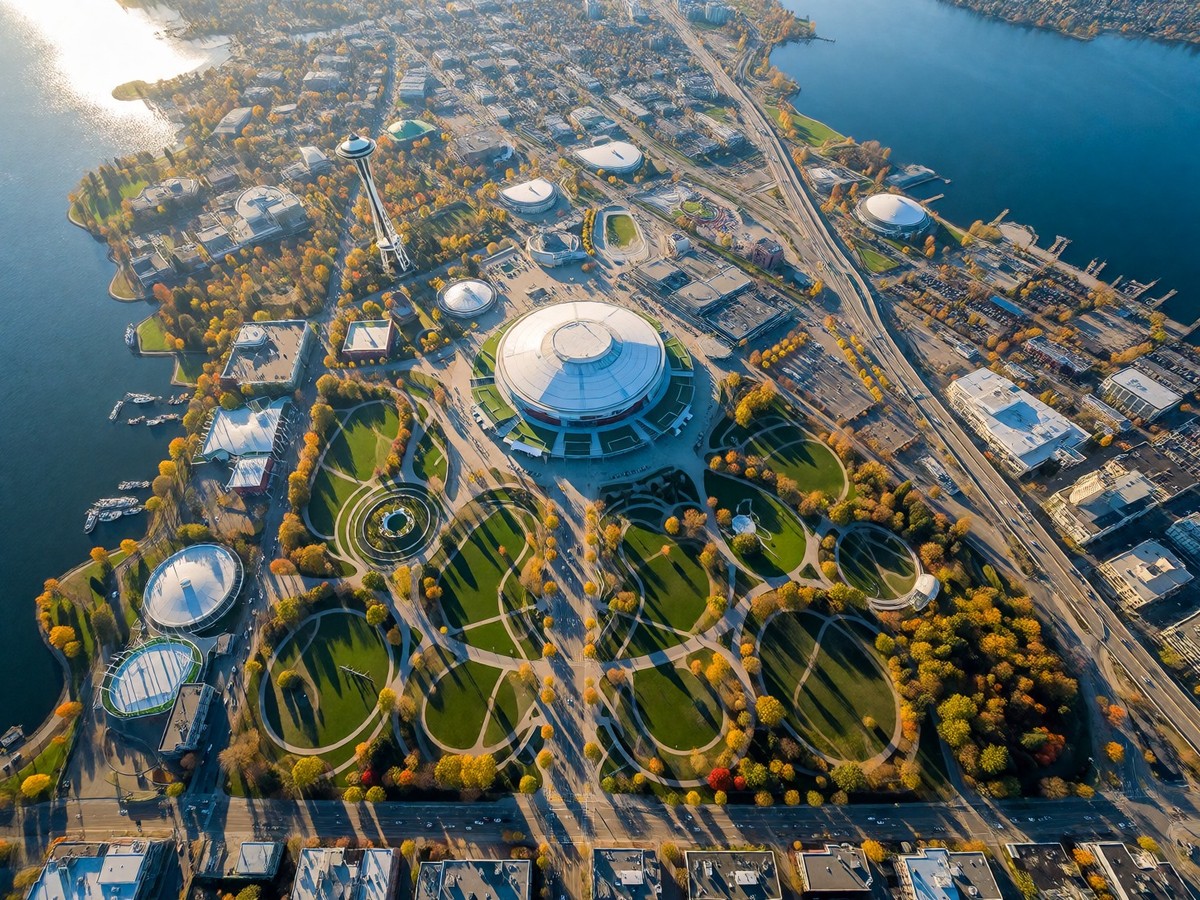
The Seattle Kraken maintains a 9-8-1 record according to recent NHL scores. The NHL consists of 32 teams, including 25 in the United States and 7 in Canada. The league awards the Stanley Cup annually to the playoff champion. The Seattle Center contains a 74-acre campus created for the 1962 World’s Fair. This campus holds the world’s first carbon-neutral sports arena. The campus also includes the Space Needle and the Museum of Pop Culture. The Museum of Pop Culture covers the history of indie video games, horror films, Nirvana, and Jimi Hendrix. I find the presence of the world’s first carbon-neutral sports arena to be a great local advantage for fans. The city’s culture depends heavily on its musical history, specifically the grunge subgenre and artists like Ray Charles. The Port of Seattle holds the status of the fourth-largest port in North America in terms of container handling.