The math behind the 2026 ATP Race to Turin
The ATP Race to Turin qualification relies on a year-to-date tally from 19 ranking events. The eighth qualification spot is determined by specific Grand Slam winner rules, which in 2026 will not change the field as no major winner ranks between eighth and 20th.

How the ATP Race works
The top seven players in the ATP Race after the Paris Masters qualify for the Nitto ATP Finals in Turin. This competition uses a year-to-date tally that begins at zero each January, unlike the 52-week rolling rankings used for seeding and tournament entry. Players earn points from 19 ranking events. These include the four Grand Slams and eight mandatory ATP Masters 1000 events, plus seven best results from other competitions. In 2026, the ATP changed the rules so that results earned in the week between the Paris Masters and the Finals count toward the following year’s PIF ATP Live Race. This change prevents players from needing to play the week before the Finals to secure points. The singles ranking relies on 18 results. These include the four Grand Slams, the eight mandatory Masters 1000 events, and the six best results from other competitions like the United Cup or ATP 500s. Monte Carlo is the one Masters 1000 event that is not mandatory and instead falls into the optional pool. For top-30 players, the ATP requires a commitment to four ATP 500 events. Because the Nitto ATP Finals is an extra event, it constitutes a 19th result that does not displace any other scoring tournament.
The eighth qualification spot
The eighth qualification spot follows specific rules regarding current-year Grand Slam winners. If a Grand Slam winner ranks between eighth and 20th in the Race, they receive a spot, otherwise the eighth-ranked player in the Race takes it. Because Carlos Alcaraz won the Australian Open, Alexander Zverev won Roland Garros and the US Open, and Jannik Sinner won Wimbledon, the three players shared all four majors, making the eighth spot a straight scrap based on total points. You should understand that the Slam clause will not change the field this year because no Grand Slam winner sits in the 8th to 20th range. If a player like Sinner had remained in the race, he would have taken a spot, but his injury withdrawal changes the math for those chasing the final positions. The 2026 scheduling rules also require top-30 players to commit to four ATP 500 events instead of the five required in previous seasons. This flexibility attempts to manage the physical load on players during a long season. If a Grand Slam winner is ranked between 8 and 20, they take the spot; if they are not, the player ranked 8th in the Race takes it.
Scoring and points
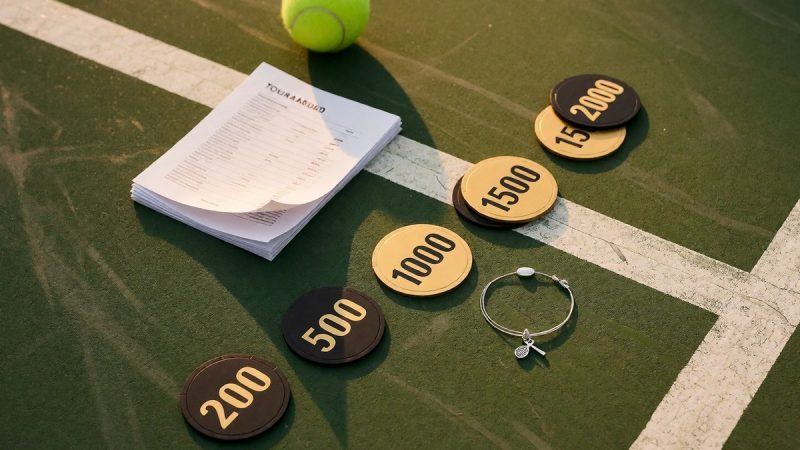
The Nitto ATP Finals generates significant points for the year-end rankings. An undefeated champion collects 1,500 points, while a finalist with a perfect group stage can earn up to 1,000 points. The tournament awards 200 points for each round-robin win, 400 points for a semifinal win, and 500 points for the final.
| Event Type | Round | Points |
|---|---|---|
| Grand Slam | Winner | 2,000 |
| Grand Slam | Finalist | 1,300 |
| ATP Masters 1000 | Winner | 1,000 |
| ATP Masters 1000 | Finalist | 650 |
| ATP 500 | Winner | 500 |
| ATP 500 | Finalist | 330 |
| ATP 250 | Winner | 250 |
| ATP 250 | Finalist | 165 |
The Paris Masters remains the last tournament to count toward the race, which means players cannot gain points during the week before the Turin event begins. This rule creates a gap where players must manage fatigue without the possibility of adding to their totals. The standings in the group stage rely on several tiebreakers if players tie in matches won. These tiebreakers include most matches played, head-to-head results, highest percentage of sets won, highest percentage of games won, and the ATP ranking after the last tournament of the year. A 2-1 record beats a 2-0 record if matches were not played. If players finish the round-robin stage with the same match record, the hierarchy of these criteria determines who advances to the semifinals. How will the remaining two spaces be decided if the current contenders fail to defend their positions?